Blog/
The Contractor on the Fence: Why Nuisance Alarms Need Site Context
By Alan Ataev, Founder & CEO, GuardMind
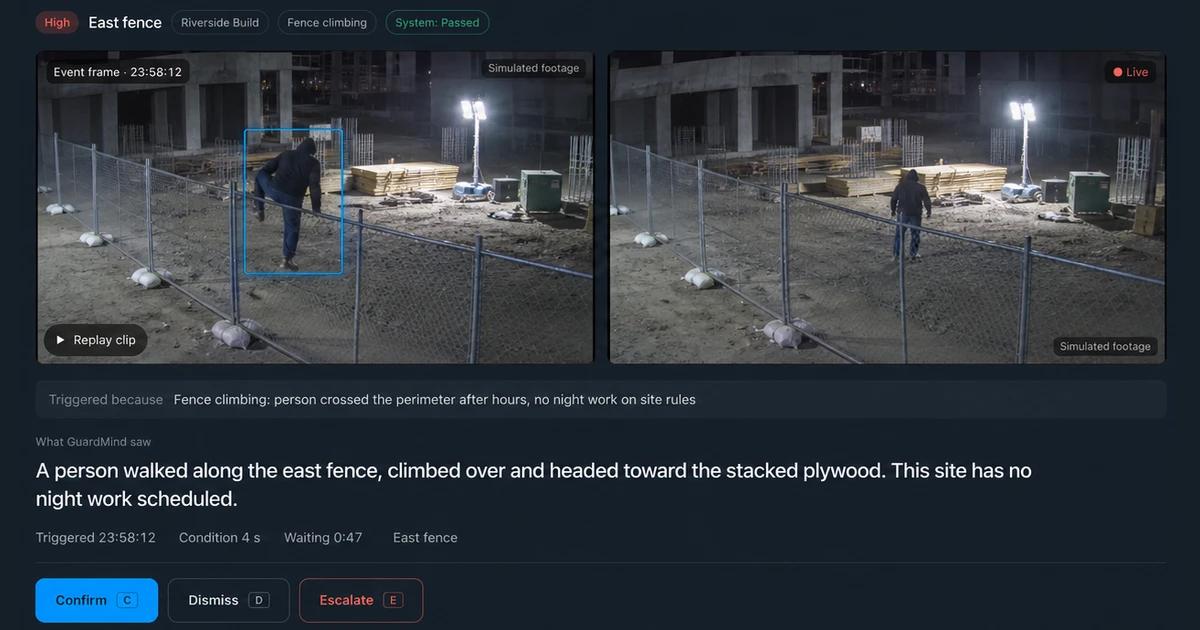
It's midnight at a construction site. A man climbs the fence on the east side. On camera, that's an intrusion.
Except the general contractor has a crew pouring concrete tonight, and he's one of them.
Anyone doing remote construction site monitoring has seen this event a hundred times. Sometimes it's a burglar. More often it's someone who was supposed to be there. The pixels look the same either way.
What is a nuisance alarm?
In video monitoring, a nuisance alarm is an event the system flags that isn't a threat: a car on the road, an animal, a tree in the wind, or a worker who is supposed to be on site.
The first three are noise in the frame, and good analytics already filter most of them. The last one is different. Nothing in the image tells you the worker belongs there. Only the site does.
Nuisance alarms cost more than operator time. In Round Rock, Texas, police define a nuisance alarm as a system with three or more false alarms in twelve months, and they stop responding to it unless the alarm is verified. Every unnecessary alert makes the next one easier to ignore.
What the industry is saying about AI video monitoring
This summer, monitoring leaders spent a lot of time on AI, and their read was fair. AI has cut false alarms from shadows, headlights and wildlife. It still struggles with context. A person on a fence can be a break-in at one property and an authorized contractor at another. A truck at the loading dock can be a theft or an early delivery.
That's true. But it's worth being precise about why.
Context is an input, not a talent
AI can't tell the contractor from the burglar because nobody told it who's expected. A new night operator at a central station monitoring hundreds of sites has the same problem until someone hands them the site notes.
So we start there. Before Reflex watches a single camera, our team sets up the rules for each site together with the customer: who belongs where, at what hours, doing what. Reflex judges every event against those rules, not against a generic idea of "suspicious."
A person on the fence at midnight, on a site where nobody should be after dark, gets escalated. The same person on a site where night work is part of the rules doesn't.
Good AI knows when to stop
One line from those industry discussions stuck with me: good AI knows when to stop.
Reflex watches, describes and escalates. It doesn't dispatch, doesn't call the police, doesn't make the life-safety call. A person does. When Reflex escalates, it says in plain language what it saw and why it matters, so whoever handles alarm verification starts with context instead of a blank clip.
When Reflex decides an event isn't worth anyone's time, it writes down why. Every dismissed event keeps its reason, so you can go back and check. A filter you can't audit is just a guess you can't see.
Where this goes
Today the rules are set by our team. Next, you'll tell Reflex in plain words, "a crew is pouring concrete on the east side tonight," and it will adjust for that night.
Try it on your noisiest site
Reflex is running on live sites today. We'll set up a free pilot on yours. Pick the site that sends the most alarms nobody needed to see.
One question: what's the event on your sites that looks like a crime but usually isn't?
Reflex is running on live sites today. Talk to us about a free pilot.