Blog/
Proactive Video Monitoring That Catches Casing
By Alan Ataev, Founder & CEO, GuardMind
Picture a closed warehouse at 1:40 AM. A man walks along the north wall. He doesn't touch anything. He stops at the back door, keeps going, comes back, stops again. Then he cups his hands against the office window and looks in.
Most systems see one of two things here. Either nothing, because classic perimeter intrusion detection waits for a line to be crossed or a door to open. Or "person detected," sitting in the same queue as the cat and the cleaner.
Twenty minutes later the glass breaks and the alarm goes off. Now your operator is watching a crime instead of stopping one.
Every break-in has a warm-up
People who break into sites usually look first. They circle the building. They try doors. They look through windows. They film the fence line on a phone, or sit in a parked car longer than anyone waiting for a pickup would.
All of it is on camera before anything happens. The camera was never the problem. Nothing watching it understood what it was seeing.
That's what proactive video monitoring is supposed to mean: catching the warm-up, not reviewing the break-in.
Reflex watches for the warm-up
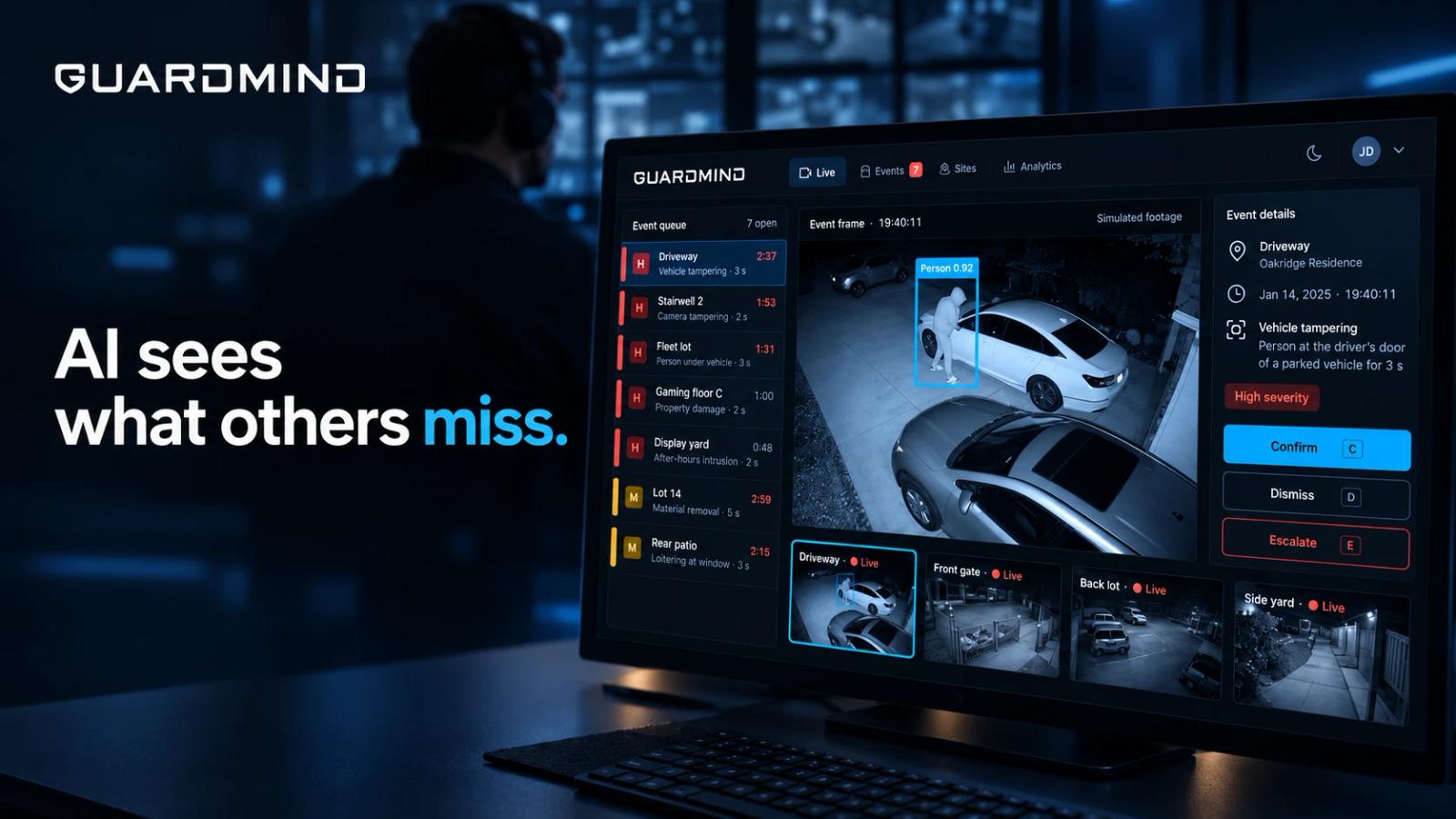
Reflex watches every live stream, every minute, and looks at what a person is doing, not just whether a person is there. When the behavior looks like someone casing the site, Reflex writes up the event in plain language. Something like: man in a dark hoodie has walked the north side twice in four minutes and stopped to look through the office window.
This isn't loitering detection with a timer. A person standing still for five minutes at a bus stop is fine. A person who walks the perimeter twice and checks every door is not.
Then it decides how urgent it is: keep watching, verify, or hand it to the operator right now. Your operator gets the event while there's still time to talk the person down, hit the lights or call it in.
It works with the cameras already on site. No rip-and-replace.
What changes when AI video monitoring does the watching
On one of our live sites, Reflex watches dozens of cameras for a specific rule violation. Before Reflex, the site caught 5 to 10 of these a day. With Reflex watching around the clock, it's about 50.
The violations didn't multiply. They were always there. Nobody can watch dozens of screens for 24 hours straight and catch everything.
One operator, many more cameras
People are bad at staring at screens and good at handling a situation. Reflex takes the staring. Your operators take the response: the talk-down, the call, the client.
For a remote video monitoring center, the same team covers far more cameras, and the events that reach them are the ones worth their time.
Why now
Two things changed. Vision AI got good enough to understand behavior on a live stream, not just detect objects. And large camera vendors started selling monitoring straight to end customers, bundling their hardware, their algorithms and their own monitoring center into one closed package.
Independent remote guarding operators won't win that fight with more hardware. They win it by catching what others miss, on whatever cameras the client already owns.
Where this goes
Today we set up the behaviors that matter on each site together with the operator: who belongs where, at what hours, doing what.
Next, Reflex learns what normal looks like on every site by itself. The truck that comes every Tuesday at 6. The cleaner who leaves at 11. Then it flags whatever doesn't fit.
Try it on your worst site
Reflex is running on live sites today. If you run a monitoring center, we'll set up a free pilot on your cameras. Pick the site where break-ins keep happening.
One question: on your sites, what does someone usually do before they break in?
Reflex is running on live sites today. Talk to us about a free pilot.